Car Body Welding Robots: Types, Working, Benefits & Applications
Car body welding robots are automated industrial machines used to join metal components during automobile manufacturing. They play an important role in producing vehicle bodies by performing welding operations with controlled movements, consistent positioning, and repeatable accuracy.
Modern automobile manufacturing involves joining multiple metal panels and structural components to create a vehicle body. These components must be assembled with appropriate strength, alignment, and dimensional accuracy.
Traditionally, many welding operations were performed manually. However, increasing production requirements and the need for consistent manufacturing quality have encouraged automobile manufacturers to adopt robotic welding systems.
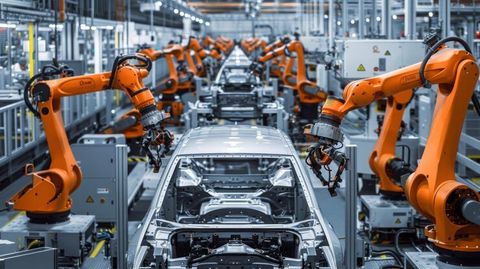
Car body welding robots commonly use robotic arms equipped with welding tools. These systems can perform operations such as spot welding, arc welding, and other specialised joining processes.
They are widely used in automotive assembly plants, vehicle body manufacturing facilities, and automotive component production units.
Why Car Body Welding Robots Are Important in Automotive Manufacturing
Automotive manufacturers must maintain consistent production quality while processing large numbers of metal components. Welding accuracy is particularly important because vehicle body structures influence strength, durability, and overall manufacturing quality.
Robotic welding systems help manufacturers manage repetitive welding operations and maintain consistency across production batches.
Their importance includes:
- Consistent welding quality: Automated movements help maintain repeatable welding positions and process parameters.
- Production efficiency: Robots can perform repetitive welding operations with consistent cycle times.
- Improved dimensional accuracy: Controlled positioning helps maintain the alignment of vehicle body components.
- Worker safety: Robots can perform certain welding tasks in environments involving heat, sparks, fumes, and repetitive movements.
- Manufacturing flexibility: Programmable systems can support different vehicle models and production requirements.
- Quality monitoring: Modern robotic systems can integrate sensors and monitoring technologies to identify process variations.
These systems are relevant to automobile manufacturers, automotive component producers, industrial engineers, automation specialists, and manufacturing facilities.
How Car Body Welding Robots Work
Car body welding robots operate through a combination of mechanical movement, electrical systems, welding equipment, and computer-based controls.
A typical robotic welding system contains several important components.
1. Robotic Arm
The robotic arm is the main mechanical structure responsible for moving the welding equipment.
It usually contains multiple joints that allow movement in different directions. This flexibility helps the robot reach specific welding positions around vehicle body components.
2. Welding Gun
The welding gun performs the actual welding operation.
In automotive manufacturing, resistance spot welding is particularly common. The welding gun applies pressure through electrodes and passes electrical current through the metal sheets to create a welded joint.
3. Robot Controller
The controller manages robotic movement and coordinates the welding process.
It stores programmed instructions and controls the robot's movement, speed, positioning, and operation sequence.
4. Power Supply
The welding power supply provides the electrical energy required for the selected welding process.
Its configuration depends on whether the system uses resistance spot welding, arc welding, or another joining technology.
5. Sensors and Vision Systems
Modern robotic welding systems may include sensors and machine vision technologies.
These systems can help identify component positions, monitor welding conditions, and detect certain manufacturing variations.
6. Safety Systems
Safety equipment includes protective fencing, interlocked access doors, emergency stop devices, and other protective measures.
These systems help prevent unintended access to hazardous robotic operating areas.
Types of Car Body Welding Robots
Different robotic welding technologies are used depending on vehicle design, material type, component thickness, and production requirements.
1. Robotic Spot Welding Systems
Robotic spot welding is one of the most widely used technologies in automotive body assembly.
It joins overlapping metal sheets through electrical resistance heating and applied pressure.
Common applications include:
- Vehicle doors.
- Roof panels.
- Side body structures.
- Floor assemblies.
- Structural body components.
2. Robotic Arc Welding Systems
Robotic arc welding uses an electric arc to join metal components through a continuous welding process.
It is commonly used for selected automotive components, brackets, structural assemblies, and fabricated parts.
3. Robotic Laser Welding Systems
Laser welding uses concentrated laser energy to join metal components.
It can provide precise welds and is used in specialised automotive applications where joint design and material characteristics make the process suitable.
4. Multi-Axis Welding Robots
Multi-axis robots have several movable joints that allow flexible positioning around complex vehicle structures.
They are useful for reaching different welding locations while maintaining controlled movement.
5. Collaborative Welding Robots
Collaborative robots, also known as cobots, are designed for applications involving closer interaction between humans and robotic equipment.
However, collaborative operation does not automatically eliminate the need for protective measures. A proper risk assessment is necessary for each application.
Applications of Car Body Welding Robots
Car body welding robots are used throughout automotive manufacturing, particularly in the body-in-white production stage.
Body-in-white refers to the vehicle body structure after major sheet-metal components have been assembled but before painting and final assembly.
Important applications include:
- Vehicle frame assembly: Joining selected structural metal components.
- Door manufacturing: Welding door panels and internal reinforcement structures.
- Roof assembly: Joining roof panels with supporting body structures.
- Floor assembly: Connecting floor panels and structural reinforcements.
- Side body assembly: Joining pillars, side panels, and related components.
- Automotive component manufacturing: Producing brackets, supports, and other metal assemblies.
- Electric vehicle manufacturing: Supporting the production of vehicle body structures and selected battery enclosure components.
The exact welding technology depends on the vehicle's engineering design and the properties of the materials being joined.
Benefits and Limitations of Robotic Welding Systems
Robotic welding systems provide several manufacturing advantages, but their implementation also involves technical and operational considerations.
| Benefits | Limitations |
|---|---|
| Consistent welding operations | Significant initial investment |
| Repeatable positioning | Requires skilled technical support |
| Reduced repetitive manual work | Regular maintenance is necessary |
| Programmable production sequences | Integration can be complex |
| Better process monitoring | Programming changes require validation |
| Support for large-scale production | Dedicated safety arrangements are required |
The suitability of robotic welding depends on production volume, component design, factory layout, welding requirements, and overall manufacturing objectives.
Recent Developments in Car Body Welding Robots During 2025–2026
Automotive manufacturing is increasingly adopting advanced automation, digital production systems, and modern robotic technologies.
Several developments are influencing the use of welding robots.
1. Updated Industrial Robot Safety Standards – February 2025
The International Organization for Standardization published revised industrial robot safety standards in February 2025.
ISO 10218-1:2025 addresses safety requirements for industrial robots, while ISO 10218-2:2025 covers industrial robot applications and robot cells.
These updated standards are relevant to robotic welding installations because they address robot design, system integration, commissioning, operation, and maintenance.
2. Artificial Intelligence and Machine Vision
AI-supported vision systems are becoming increasingly relevant to automated manufacturing.
In robotic welding applications, machine vision can help identify component positions, inspect weld-related features, and detect certain manufacturing variations.
These technologies can support more consistent production monitoring, although their effectiveness depends on system design and inspection requirements.
3. Electric Vehicle Manufacturing Expansion
The development of electric vehicles is influencing automotive production methods.
Manufacturers are processing different body structures, battery enclosures, and lightweight materials. This creates additional requirements for flexible joining technologies and automated manufacturing systems.
4. Growth of India's Automotive Manufacturing Sector
According to the Ministry of Heavy Industries, India's Production Linked Incentive Scheme for Automobiles and Auto Components had attracted cumulative investment of ₹52,806 crore by September 30, 2026.
The scheme had also generated 77,755 employment opportunities by that date, according to government figures published on November 25, 2026.
Although the scheme does not specifically subsidise car body welding robots, its broader focus on advanced automotive manufacturing supports the development of India's automotive production ecosystem.
Laws, Policies, and Safety Standards in India
Car body welding robots operate in industrial environments involving electrical equipment, moving machinery, high temperatures, welding fumes, and potential fire hazards.
Manufacturers and factory operators must consider applicable workplace safety and machinery requirements.
1. Occupational Safety, Health and Working Conditions Code, 2020
The Occupational Safety, Health and Working Conditions Code, 2020, came into effect on November 21, 2025.
It establishes a consolidated framework covering workplace safety, employee health, and working conditions.
Automotive manufacturing facilities must consider applicable requirements concerning machinery safety, worker protection, training, and workplace risk management.
2. Occupational Safety, Health and Working Conditions Central Rules, 2025
The Central Government notified the Occupational Safety, Health and Working Conditions (Central) Rules, 2025, in the Gazette of India.
These rules provide further provisions for implementing the workplace safety framework. Applicable state rules must also be considered.
3. ISO 10218 Industrial Robot Safety Standards
ISO 10218-1:2025 and ISO 10218-2:2025 provide internationally recognised safety guidance for industrial robots and robotic applications.
They are relevant to robotic welding systems, particularly their integration, protective arrangements, operation, and maintenance.
4. Environmental and Pollution Control Requirements
Automotive manufacturing facilities must consider applicable environmental regulations concerning industrial emissions, waste management, and workplace pollution control.
Welding operations may require appropriate fume extraction and ventilation arrangements.
5. Electrical and Fire Safety
Robotic welding systems use electrical power and generate heat and sparks.
Factories should establish appropriate electrical protection, emergency arrangements, fire prevention measures, equipment inspection, and operator training.
Tools and Resources for Car Body Welding Robots
Several technical tools and resources support the design, integration, operation, and maintenance of automotive robotic welding systems.
- CAD Software: Used to prepare vehicle body designs and component drawings.
- Robot Simulation Software: Helps evaluate robot movements, reachability, cycle times, and potential interference before physical installation.
- Offline Programming Software: Supports the preparation and review of robotic movement programs.
- Welding Parameter Monitoring Systems: Help monitor welding process conditions and identify variations.
- Machine Vision Systems: Support component positioning, inspection, and manufacturing quality checks.
- Preventive Maintenance Software: Helps maintain equipment inspection records and maintenance schedules.
- Quality Management Systems: Support production documentation, weld inspection records, and process traceability.
- Robot Safety Assessment Tools: Help identify potential hazards and evaluate protective arrangements.
Useful technical references include the Bureau of Indian Standards, International Organization for Standardization, Ministry of Heavy Industries, and industrial robot manufacturers' technical documentation.
Frequently Asked Questions About Car Body Welding Robots
1. What are car body welding robots used for?
Car body welding robots are used to join metal components during automobile manufacturing. Common applications include vehicle doors, roof panels, floor structures, side body assemblies, and other body-in-white components.
2. Which welding process is most commonly used in car manufacturing robots?
Resistance spot welding is one of the most widely used robotic welding processes in automotive body assembly. It joins overlapping metal sheets using electrical resistance heating and applied pressure.
3. What are the main advantages of automotive welding robots?
Their main advantages include repeatable welding operations, consistent positioning, production efficiency, reduced repetitive manual work, and improved process monitoring.
4. Can welding robots work with electric vehicle body structures?
Yes. Robotic welding systems can support the manufacturing of electric vehicle body structures and selected metal components. The appropriate joining technology depends on material properties, component design, and engineering requirements.
5. What safety precautions are necessary for robotic welding systems?
Important precautions include protective fencing, safety interlocks, emergency stop systems, welding fume extraction, electrical protection, fire prevention, regular equipment inspection, and appropriate worker training.
Conclusion
Car body welding robots are an important part of modern automotive manufacturing. They help manufacturers join vehicle body components through controlled, repeatable, and automated welding operations.
Technologies such as resistance spot welding, robotic arc welding, laser welding, and machine vision support different automotive production requirements.
Recent developments in industrial robotics, artificial intelligence, electric vehicle manufacturing, and international safety standards are influencing the future of automotive welding automation.
In India, expanding automotive manufacturing capabilities and increasing attention to industrial automation are creating a stronger technological foundation for modern vehicle production.
Understanding robot types, welding processes, applications, safety requirements, and relevant regulations helps manufacturers and engineering professionals evaluate the role of robotic welding systems in automotive production.

Related Post...

Slotting Machines: Uses, Working, Types and Industrial Applications
Updated: November 25, 2026
Read More
Plasma Cutting Machines: Types, Working Principles, Uses & Safety Guide
Updated: November 27, 2026
Read More