Industrial Conveyor Belts: Types, Uses and Applications
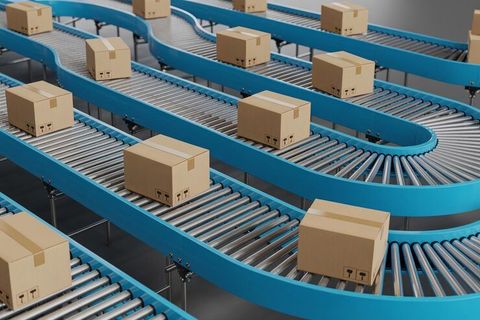
Industrial conveyor belts are mechanical systems designed to transport materials, products and components from one location to another. They are widely used in manufacturing plants, warehouses, mining operations, food processing facilities, packaging units and logistics centres.
A conveyor belt generally consists of a continuous moving belt supported by rollers or pulleys. An electric motor drives the system, allowing materials to move along a predetermined path.
The main purpose of industrial conveyor belts is to simplify material handling and reduce the need for repeated manual movement. They help industries transport materials over short or long distances while maintaining an organised production flow.
Different conveyor belt designs are developed according to the weight, size, shape and characteristics of the materials being transported.
Common components include:
Belt: The moving surface that carries materials.
Drive pulley: Transfers motor power to the belt.
Idler rollers: Support the belt during movement.
Electric motor: Provides the mechanical power required for operation.
Take-up system: Maintains appropriate belt tension.
Frame: Supports the conveyor structure.
Control system: Regulates speed, direction and operating functions.
Importance of Industrial Conveyor Belts in Modern Industries
Industrial conveyor belts are important because modern manufacturing and logistics operations involve the continuous movement of materials.
Without organised material handling, industries may experience production delays, workplace congestion and difficulties managing large quantities of goods.
Conveyor systems help address these challenges by connecting different stages of production and transportation.
They are particularly relevant to manufacturers, mining companies, warehouse operators, food processors, packaging industries and logistics facilities.
Major problems addressed by conveyor belt systems include:
Repeated manual movement of heavy materials.
Delays in production and material transportation.
Inefficient movement between processing stages.
Difficulties handling bulk materials.
Congestion in warehouses and manufacturing facilities.
Inconsistent material flow.
Increased physical handling requirements.
Industrial applications of conveyor belts
Industry | Application | Main Purpose |
|---|---|---|
Mining | Coal and mineral transportation | Bulk material movement |
Manufacturing | Assembly line transportation | Production flow |
Food processing | Food product handling | Processing and packaging |
Logistics | Parcel transportation | Material distribution |
Agriculture | Grain transportation | Agricultural processing |
Cement | Limestone and clinker movement | Bulk handling |
Automotive | Component movement | Assembly operations |
Pharmaceuticals | Product handling | Controlled manufacturing |
Recent Developments and Industry Trends in 2025–2026
Industrial conveyor technology is evolving through improvements in material handling, automation, energy efficiency and workplace safety. India's mining, steel, cement and manufacturing sectors are important areas of development.
Late 2025 – Expansion of Coal Material Handling Infrastructure
Coal India continued expanding its First Mile Connectivity programme, which integrates conveyor systems, coal handling plants, silos and rapid loading infrastructure. The programme aims to improve mechanised coal transportation and reduce dependence on conventional road-based movement.
9 April 2026 – Advanced Conveyor Project in Odisha
The Taldih iron ore mining project in Odisha announced plans for an advanced Flyingbelt conveyor system. The planned installation covers approximately 2,800 metres and is designed for a transportation capacity of 2,000 tonnes per hour.
The project uses a specialised suspended conveyor arrangement to transport iron ore across challenging terrain. It is expected to enter operation in 2027.
8 July 2026 – Conveyor Infrastructure at NALCO
MECON completed trial runs of two major conveyor systems for NALCO's 1.0 MTPA alumina refinery expansion project at Damanjodi, Odisha.
The conveyors form part of the bauxite storage, handling and secondary crushing infrastructure, demonstrating the importance of material transportation systems in mineral processing.
6 October 2026 – Revised Indian Conveyor Belt Standards
The Bureau of Indian Standards established several revised standards relating to conveyor belt dimensions, tensile strength and testing methods.
Important updates include:
IS 17114:2026 – Conveyor belts with textile carcass: widths and lengths.
IS 17496:2026 – Textile conveyor belt tensile strength and elongation testing.
IS 16365:2026 – Light conveyor belt coefficient of friction testing.
IS 15148:2026 – Electrical conductivity characteristics and testing of antistatic belts.
These standards align with updated international ISO references and are relevant to conveyor belt design, testing and technical evaluation.
Other important technology trends include:
Smart conveyor systems with automated monitoring.
Energy-efficient electric drive systems.
Predictive maintenance using vibration sensors.
Automated belt alignment and tracking.
Fire-resistant and antistatic belt materials.
Advanced sorting and warehouse automation.
Long-distance and high-capacity bulk material transportation.
Laws and Policies Affecting Industrial Conveyor Belts in India
Industrial conveyor systems must follow applicable regulations concerning machinery safety, workplace conditions, mining operations and technical standards.
The specific requirements depend on the industry, installation environment and materials being transported.
1. Occupational Safety, Health and Working Conditions Code, 2020
The Occupational Safety, Health and Working Conditions Code came into force on 21 November 2025.
It establishes a framework for workplace health, safety and working conditions in applicable industrial establishments.
For conveyor installations, important safety considerations include machine guarding, safe access, worker training, maintenance procedures and protection against moving machinery.
2. Bureau of Indian Standards (BIS)
BIS develops technical standards covering conveyor belt dimensions, strength, performance and testing.
Relevant standards include IS 1891 for rubber conveyor belting and the revised 2026 standards for textile conveyor belt characteristics and testing.
Manufacturers and industrial operators should verify the latest applicable editions when specifying or evaluating conveyor belts.
3. Directorate General of Mines Safety (DGMS)
Mining conveyor installations must comply with applicable mining safety regulations and DGMS requirements.
Important safety arrangements include:
Emergency stop switches.
Pull-cord safety systems.
Belt alignment monitoring.
Suitable electrical protection.
Sequential conveyor interlocking.
Protection against material rollback.
Mining conveyor installations also require appropriate inspection and operational controls.
4. Ministry of Steel Safety Guidelines
The Ministry of Steel has published safety guidance for conveyor belt operation and maintenance in iron and steel facilities.
The guidelines address hazards such as rotating machinery, belt entanglement, falling materials and unexpected equipment movement.
They emphasise guarding, emergency controls, suitable protective equipment and safe maintenance procedures.
5. Environmental Regulations
Industrial conveyor installations may also be subject to environmental requirements concerning dust emissions, noise, material spillage and waste management.
Depending on the facility, applicable permissions and environmental conditions may involve the Central Pollution Control Board and relevant State Pollution Control Board.
Tools and Resources for Industrial Conveyor Belts
Industrial conveyor systems require proper engineering calculations, monitoring equipment and maintenance procedures to maintain operational reliability.
The following tools and technical resources are useful for conveyor system planning and evaluation.
Tool or Resource | Main Application |
|---|---|
AutoCAD | Conveyor layout and structural drawings |
SolidWorks | Mechanical conveyor design |
ANSYS | Structural and mechanical simulation |
Microsoft Excel | Conveyor capacity calculations |
Belt Analyst | Conveyor system engineering analysis |
Siemens TIA Portal | Industrial automation and control |
SKF condition monitoring | Bearing and machinery monitoring |
Vibration sensors | Equipment condition analysis |
Thermal imaging cameras | Detecting abnormal heating |
ISO 5048 | Conveyor capacity and power calculation principles |
Important conveyor belt calculations
Several engineering parameters help determine conveyor performance.
Belt Speed: The speed at which the conveyor belt moves.
Belt Capacity: The quantity of material transported over a specific period.
Belt Tension: The force acting along the conveyor belt.
Motor Power: The mechanical power required to move the belt and its load.
Conveyor Length: The distance covered by the transportation system.
A simplified belt speed formula is:
Where:
= Belt speed in metres per second.
= Drive pulley diameter in metres.
= Pulley rotational speed in revolutions per minute.
Actual conveyor design also considers material density, inclination, friction, loading conditions and belt characteristics.
Important maintenance activities
Regular inspection helps identify potential problems before they affect conveyor operations.
Check belt alignment and tracking.
Inspect pulleys, rollers and bearings.
Monitor belt tension.
Examine belt joints and surface damage.
Check motor and gearbox performance.
Remove accumulated material safely.
Inspect emergency stop systems.
Monitor abnormal vibration and temperature.
Maintenance activities should follow equipment instructions and appropriate isolation procedures.
Frequently Asked Questions About Industrial Conveyor Belts
1. What are industrial conveyor belts used for?
Industrial conveyor belts are used to transport materials, products and components within manufacturing plants, warehouses, mining facilities, cement plants and food processing units. They support organised material movement and continuous production operations.
2. What are the main types of industrial conveyor belts?
Common types include flat belts, modular plastic belts, rubber conveyor belts, roller conveyors, cleated belts, troughed belts and steel cord conveyor belts. Each type is designed for particular materials and operating conditions.
3. Which conveyor belt is commonly used in mining industries?
Rubber conveyor belts, textile-reinforced belts and steel cord conveyor belts are commonly used in mining. The selection depends on transportation distance, material weight, operating conditions and required belt strength.
4. How is conveyor belt capacity calculated?
Conveyor belt capacity is generally calculated using belt speed, material density and the cross-sectional area of material carried on the belt. Conveyor inclination and loading conditions also influence the actual transportation capacity.
5. How can industrial conveyor belt safety be maintained?
Safety can be maintained through proper machine guarding, emergency stop switches, regular inspections, belt alignment monitoring, worker training and safe maintenance procedures. Conveyor systems should be isolated before maintenance or repair activities.
Conclusion
Industrial conveyor belts are an essential part of modern material handling and manufacturing infrastructure. They support the transportation of raw materials, components and finished products across industries such as mining, cement, steel, agriculture, food processing and logistics.
Different conveyor technologies address different operational requirements, from lightweight product transportation to heavy-duty bulk material handling.
Recent developments in India demonstrate increasing attention to advanced conveyor infrastructure, automated material handling, improved belt standards and mining transportation systems.
However, reliable conveyor operation depends on appropriate equipment selection, regular maintenance, engineering calculations and compliance with workplace safety requirements.
As industrial automation and infrastructure development continue to expand, conveyor belt systems will remain an important part of efficient material transportation and modern industrial operations.
SEO note: Use the primary keyword naturally in the page title, introduction, meta description and relevant subheadings. The article is informational and avoids exaggerated performanc.

Related Post...
Generative AI in Manufacturing: Applications, Benefits & Future Trends
Updated: November 26, 2026
Read More