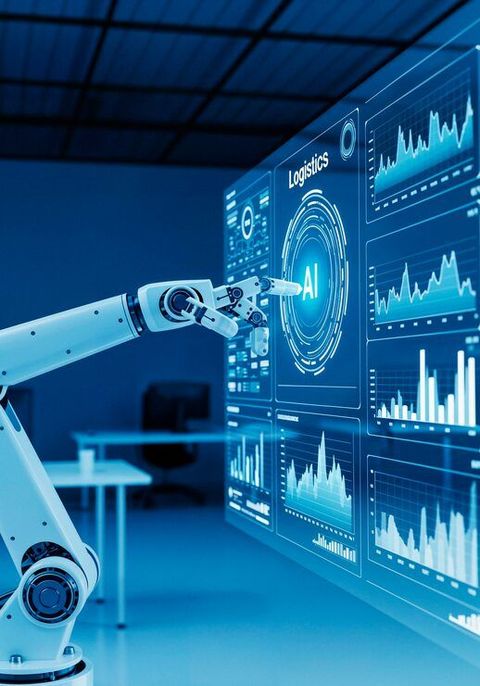
Artificial Intelligence in Industries: Applications, Benefits and Future Trends
Artificial Intelligence (AI) is a technology that enables computers and machines to perform tasks that normally require human intelligence. These tasks include understanding language, recognising images, analysing information, identifying patterns and supporting decision-making.
Artificial intelligence exists because businesses, institutions and governments increasingly need to process large amounts of information accurately and efficiently. Traditional computer systems generally follow predefined instructions, whereas AI systems can identify patterns in data and improve their performance through machine learning.
Today, artificial intelligence is becoming an important part of industrial development. It is changing how different sectors operate, manage information and approach everyday challenges.
In India, AI adoption is growing across several industries, including manufacturing, healthcare, banking, agriculture, education, transportation and retail.
Some important AI technologies include:
- Machine Learning: Enables computer systems to learn patterns from data.
- Natural Language Processing: Helps computers understand and generate human language.
- Computer Vision: Allows machines to interpret images and videos.
- Generative AI: Creates text, images, audio and other digital content.
- Robotics and Automation: Supports machines in performing repetitive or complex physical tasks.
- Predictive Analytics: Uses historical information to estimate possible future outcomes.
Why Artificial Intelligence Matters Today
Artificial intelligence matters because industries face increasing demands for accuracy, productivity, better planning and reliable information management. AI can help organisations address these challenges through data analysis, automation and intelligent decision-making.
Its influence extends beyond large corporations. Small businesses, educational institutions, healthcare organisations, manufacturers, farmers and ordinary consumers can also experience its effects.
Major problems AI helps address include:
- Repetitive administrative activities that require considerable time.
- Errors in data processing and quality inspection.
- Delays in identifying equipment problems.
- Difficulties analysing large datasets.
- Limited access to specialised information.
- Challenges in forecasting demand and managing resources.
Impact across different industries
| Industry | Application of AI | Main Purpose |
|---|---|---|
| Healthcare | Medical image analysis | Support diagnosis |
| Manufacturing | Predictive maintenance | Reduce equipment downtime |
| Banking | Fraud detection | Identify unusual transactions |
| Agriculture | Crop monitoring | Improve farming decisions |
| Education | Adaptive learning | Support individual learning |
| Retail | Demand forecasting | Improve inventory planning |
| Transportation | Traffic prediction | Improve route planning |
| Energy | Smart grid analytics | Manage energy distribution |
Applications of Artificial Intelligence Across Industries
Artificial intelligence has different applications depending on the requirements of each industry. Its usefulness depends on data quality, system reliability and appropriate human supervision.
1. Healthcare Industry
AI is helping healthcare professionals analyse medical images, organise patient information and identify patterns that may require further investigation.
Common applications include:
- Medical image analysis.
- Early disease screening support.
- Patient data management.
- Drug discovery research.
- Hospital resource planning.
AI-generated results should be reviewed by qualified healthcare professionals before clinical decisions are made.
2. Manufacturing Industry
Manufacturing organisations use AI to improve production processes and monitor industrial equipment.
Predictive maintenance systems analyse machine performance and identify warning signs before equipment failures occur. Computer vision can also help identify defects during product inspections.
These applications support quality management, production planning and industrial automation.
3. Banking and Finance Industry
Financial institutions use AI to analyse transaction patterns, identify suspicious activities and support risk assessment.
Important applications include fraud detection, credit risk analysis, customer query management and financial forecasting.
However, automated financial decisions require appropriate safeguards to prevent unfair treatment and inaccurate assessments.
4. Agriculture Industry
AI is becoming useful in modern agriculture, particularly for analysing weather information, soil conditions and crop health.
Applications include crop disease identification, satellite-based field monitoring, irrigation planning and agricultural forecasting.
These technologies can help farmers make more informed decisions, although local conditions and expert agricultural guidance remain important.
5. Education Industry
Educational institutions are exploring AI-powered learning systems to support students and teachers.
AI can assist with language learning, educational content development, personalised practice exercises and administrative activities.
Teachers remain essential for evaluating student understanding, encouraging critical thinking and maintaining educational quality.
6. Retail and Transportation
Retail organisations use AI for inventory analysis, demand forecasting and understanding purchasing patterns.
In transportation, AI supports traffic monitoring, route optimisation, logistics planning and vehicle safety research.
These applications demonstrate how AI can improve planning and information management across different economic activities.
Recent AI Developments and Industry Trends in India
Artificial intelligence has experienced important developments in India during 2025 and 2026. Government initiatives, domestic research and increased computing infrastructure are supporting the expansion of the country's AI ecosystem.
Some notable developments include:
5 November 2025 – India AI Governance Guidelines
The Ministry of Electronics and Information Technology introduced the India AI Governance Guidelines. The framework established seven guiding principles, including trust, human-centred development, fairness, accountability, transparency and safety. These principles encourage responsible AI development and adoption across industries.
29 January 2026 – Economic Survey 2025–26
India's Economic Survey highlighted the importance of practical, application-driven AI development. It discussed applications in healthcare, agriculture, education, urban management and disaster preparedness. It also emphasised the importance of developing AI solutions suited to India's local requirements.
11 February 2026 – Expansion of India's AI Ecosystem
Government updates highlighted the progress of the IndiaAI Mission, including the development of shared computing infrastructure and indigenous AI capabilities.
29 July 2026 – AI Adoption in Public Administration
The government reported that the IndiaAI Mission had identified 762 AI use cases across 62 ministries. It also highlighted the approval of 58 AI Centres of Excellence and 543 Data and AI Labs.
August 2026 – Increased AI Computing Infrastructure
Government information reported that shared computing capacity under the IndiaAI Mission had expanded beyond 45,000 GPUs. The initiative supports AI research, model development and innovation.
These developments indicate growing attention towards domestic AI infrastructure, Indian-language models, responsible AI and practical applications.
Laws and Policies Governing Artificial Intelligence in India
Artificial intelligence in India is influenced by several existing laws, government guidelines and industry-specific regulations.
Although India has introduced national AI governance guidance, organisations must also consider applicable data protection, cybersecurity, intellectual property and sector-specific requirements.
1. Digital Personal Data Protection Act, 2023
The Digital Personal Data Protection (DPDP) Act establishes a legal framework for processing digital personal data in India.
It is particularly relevant to AI systems that collect, analyse or process personal information.
Important areas include:
- Appropriate handling of personal data.
- Consent and permitted data processing.
- Protection of individual privacy.
- Data security and accountability.
- Applicable rights of individuals.
The DPDP Rules were notified on 13 November 2025 with a phased commencement schedule. Several substantive provisions are scheduled to take effect 18 months after publication, in May 2027.
2. Information Technology Act, 2000
The Information Technology Act provides an important legal foundation for electronic records, digital activities and certain cyber-related offences.
Its provisions may become relevant when AI applications involve unauthorised access, misuse of information or other unlawful digital activities.
3. India AI Governance Guidelines, 2025
Released on 5 November 2025, these guidelines provide a national framework for responsible AI development and deployment.
Their seven principles emphasise:
- Trust and reliability.
- Human-centred development.
- Fairness and equality.
- Accountability.
- Understandable AI systems.
- Safety and security.
- Environmental sustainability.
The guidelines work alongside existing laws rather than creating a separate comprehensive AI statute.
4. IndiaAI Mission
Approved on 7 March 2024, the IndiaAI Mission has an allocated outlay of approximately ₹10,372 crore over five years.
Its objectives include strengthening AI computing infrastructure, supporting domestic AI models, improving access to datasets, developing talent and encouraging responsible innovation.
Organisations must also follow relevant regulations issued by sectoral authorities, including the Reserve Bank of India and other applicable regulators.
AI Tools and Resources for Different Industries
Several AI platforms and technical resources support research, content development, data analysis, automation and industrial applications.
The following examples serve different purposes:
| Tool or Resource | Main Application |
|---|---|
| ChatGPT | Research assistance and language-based tasks |
| Google Gemini | Information analysis and content assistance |
| Microsoft Copilot | Workplace productivity |
| TensorFlow | Machine learning development |
| PyTorch | AI model development and research |
| IBM watsonx | Enterprise AI development and governance |
| Power BI | Data visualisation and business analytics |
| Tableau | Data analysis and reporting |
| Google Cloud AI | Cloud-based machine learning |
| AI Kosh | Indian AI datasets and models |
How to select an appropriate AI tool
Before adopting an AI platform, organisations should consider:
- Data privacy and security requirements.
- Accuracy and reliability of results.
- Compatibility with existing systems.
- Ease of use and technical requirements.
- Transparency and accountability.
- Human oversight and monitoring.
The appropriate technology depends on the organisation's objectives, industry requirements and available technical infrastructure.
Frequently Asked Questions About Artificial Intelligence in Industries
1. What is artificial intelligence in industries?
Artificial intelligence in industries refers to the use of intelligent computer systems and machine learning technologies to perform tasks such as data analysis, automation, forecasting, image recognition and decision support. It is used across sectors including healthcare, manufacturing, finance and agriculture.
2. Which industries use artificial intelligence the most?
Manufacturing, banking, healthcare, retail, transportation and technology are among the major sectors adopting AI. Agriculture and education are also increasingly exploring AI-based applications.
3. How does AI improve industrial productivity?
AI can analyse information, automate repetitive activities, identify operational problems and support better planning. Predictive maintenance and automated quality inspection are examples of applications that can improve industrial processes.
4. Is artificial intelligence regulated in India?
Yes. AI-related activities are affected by existing laws, including the Information Technology Act, 2000, and the Digital Personal Data Protection Act, 2023, along with sector-specific regulations. India's AI Governance Guidelines, introduced in November 2025, also provide principles for responsible AI development and adoption.
5. What is the future of artificial intelligence in industries?
The future of AI is likely to involve greater automation, advanced robotics, generative AI, predictive analytics and industry-specific AI models. Indian-language technologies, domestic computing infrastructure and responsible AI development are also expected to remain important areas of progress.
Conclusion
Artificial intelligence is becoming an important part of modern industrial development. Its applications extend across healthcare, manufacturing, banking, agriculture, education, retail and transportation.
By supporting data analysis, automation, forecasting and decision-making, AI can help industries address operational challenges and improve existing processes.
India's growing AI ecosystem, supported by the IndiaAI Mission and national governance initiatives, reflects the country's interest in developing responsible and locally relevant AI technologies.
However, successful AI adoption requires more than advanced technology. Data protection, cybersecurity, transparency, fairness and human supervision must remain important considerations.
As AI continues to develop, its long-term contribution will depend on how effectively industries combine technological capabilities with human knowledge, accountability and responsible practices.

Related Post...

Electric Vehicles and Battery Manufacturing in India: Trends and Policies
Updated: November 26, 2026
Read More
Industrial Cybersecurity and Data Protection in India: Laws, Trends and Security
Updated: November 26, 2026
Read More